 Codeman maintainer
09daf0fe49
Codeman maintainer
09daf0fe49
Lineage lines used to draw one glowing dashed bezier per parent/child pair,
hanging below the tab strip, for every family at once. With a parent on row 3
of a wrapped strip and ten children below it, the curves crossed every lower
row's tab names and ran through the terminal text.

- One rounded orthogonal tree per spawning tab: every route starts at the
  parent, so siblings share a trunk. 1.5px, solid, 1px dark outline; only a
  working child's branch is dashed.
- Routes run only through the gaps between tab rows, joined by a spine left of
  every row (computeLineageTree/computeLineageRows in constants.js), so they
  never cross a tab or reach the terminal. The vertical rail gets the same tree
  on its existing left track.
- Only the selected tab's family is drawn (what it spawned, plus its parent and
  siblings). Selection redraws, and the strip's size transitionend redraws once
  more, since the active tab widens for ~150ms after the selection redraw.
- The routing room is reserved by .session-tabs.lineage-tree, keyed on whether
  any lineage exists, never on the selection, so a tab switch never resizes the
  header or the PTY.
- Colours stay per spawning tab, now claimed in strip order for every family so
  selection order never decides who gets the skin blue.

Co-Authored-By: Claude Opus 5.5 (1M context) <noreply@anthropic.com>
5.2 KiB
Watching Agents Work
Modern agents fan out. A single Claude session can be running six subagents, and the parent terminal shows you almost none of it. Codeman surfaces that hidden work as live windows, panels, and after-the-fact summaries.
Everything on this page is Claude-only. It reads Claude Code's transcripts and team state; the other CLIs expose no equivalent.
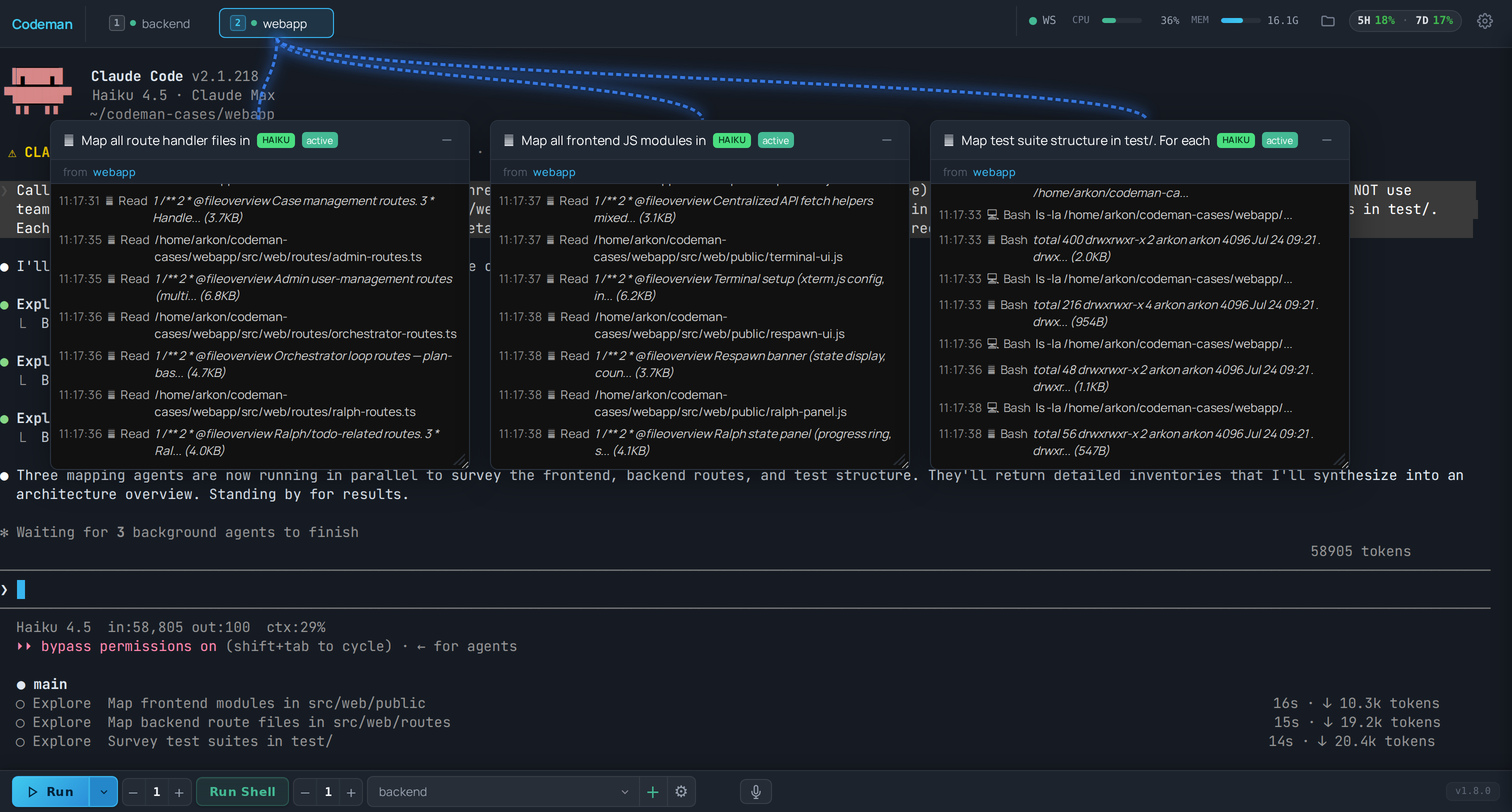
Subagent windows
When a Claude session spawns subagents, each one gets its own floating window with a live transcript: what it was asked to do, what it is doing, and what it returned.
- Windows are draggable and resizable, and their positions persist across reloads.
- A connection line links each window to the session tab that spawned it, so with four sessions running you can still tell whose worker is whose.
- Closing a window does not stop the subagent. It only stops you watching it.
This is the feature that makes a fan-out legible. Without it, a lead session that spawned eight workers looks like a stalled terminal for several minutes.
Session lineage lines
Select a tab and the tab strip draws lines from it to every tab it spawned, and to the tab that spawned it (with its siblings). That covers the other direction of fan-out: not subagents inside one session, but whole sessions started by an agent through the API.
The lines form one tree per spawning tab, in that tab's colour, and run only through the gaps between tab rows, so they never cover a tab name or the terminal. A dashed branch means that child is working. Tabs with no lineage draw nothing.
Desktop only, on by default, and toggled in App Settings → Appearance. Lines are skipped for tabs scrolled out of view.
See Driving Codeman From An Agent for the spawning side.
Agent teams
Claude Code's experimental agent teams appear as teammates alongside subagents. Enable them in the CLI's own environment:
CLAUDE_CODE_EXPERIMENTAL_AGENT_TEAMS=1
and turn the per-case Agent Teams toggle on in the case settings gear.
Codeman watches the team directory and matches teammates to the session leading them. Teammates are in-process threads rather than separate CLI processes, so they show up as windows, not tabs.
Notes and the experiment log:
docs/agent-teams/.
Ultracode and workflow runs
When Claude runs a Workflow, dozens of agents can be in flight at once. The completion artifact for a run is only written at the end, so a live run would otherwise be invisible until it finished. Codeman synthesizes the in-flight view from the transcripts and lets the real artifact supersede it when it lands.
Two independent toggles, both off by default:
| Setting | Shows |
|---|---|
| Ultracode panel | A docked panel listing the run's agents. |
| Ultracode windows | Floating windows, like subagents. |
Turning on either starts the watcher.
Reading the answer, not the terminal
Last Response (header button, opt-in) renders the agent's last answer as scrollable text rather than terminal output. It exists mostly for phones, where reading a long answer in a terminal viewport is painful. More loads additional context.
After the fact
| Surface | Answers |
|---|---|
| Away Digest | What happened while I was gone? |
| Run summary | What did this run actually do? |
| Lifecycle log | When did sessions start, exit, or get killed, and why? |
| Token stats | What did it cost? |
The Away Digest aggregates the lifecycle log, run summary events, live sessions, token statistics, and recent subagents into one view. It is the right first thing to open in the morning after an overnight run.
All of these header buttons are opt-in: App Settings → Header & Panels.
Performance
The design target is 20 sessions and 50 agent windows at 60fps. If you routinely run more than that, expect the browser rather than the server to be the limit, and close windows you are not reading.
Gotchas
- A session pointed at a relocated Claude config directory goes blind here. Transcripts
written outside
~/.claude/projectsare invisible to the watchers, so subagent windows, the ultracode panel, the response viewer, and Read My Mind all stop working for that session. Symlinkprojectsback into the shared tree to fix it. See Agent CLIs. - Closing a window does not cancel the agent. Nothing on this page controls agents; it observes them.
- Windows are opt-in for ultracode, automatic for subagents.
Read next
- The Dashboard - where these surfaces live.
- Driving Codeman From An Agent - the other kind of fan-out.
- Autonomous Loops - the loops that generate this much activity.